
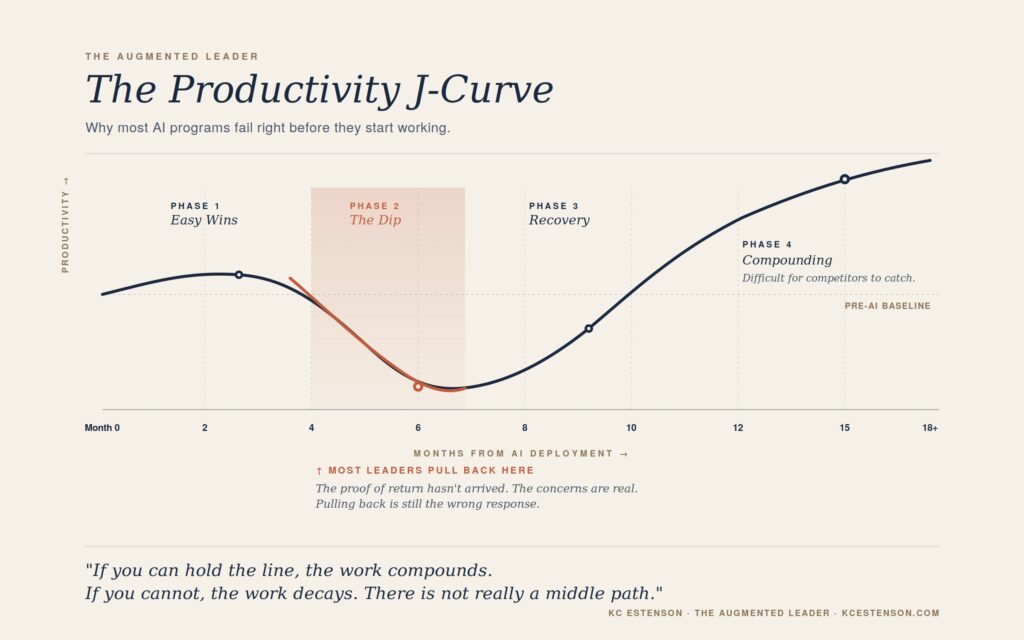
Anthropic recently published something every senior leader should read carefully. Their enterprise adoption research has a finding buried inside it that explains nearly every AI program failure I have seen in the last two years. They call it the productivity J-curve.
Here is the idea. When an organization deploys AI seriously, productivity does not climb in a straight line. It dips first. Leaders are learning new tools. Teams are unlearning old habits. People are experimenting with workflows that do not yet have proven returns. The work is slower for a stretch, sometimes weeks, sometimes a few months. Then, if the program holds together, the curve turns. Productivity rises. It rises faster. The team that was slower in week four is meaningfully ahead of where they started, and pulling away from competitors who never made it through the dip.
Most AI programs do not fail because the technology does not work. They fail because senior leaders see the dip and quiet quit before the curve turns up.
That is the pattern. It is so consistent across companies that I now think of it as the single biggest leadership challenge in AI adoption. Not the choice of tools. Not the prompt engineering. Not the change management theater that gets so much attention in the trade press. The real challenge is the conviction required to hold the line in months four through six, when the program is costing money, attention, and patience, and the proof of return has not yet arrived.
AI Program Failure: A Pattern I Have Watched Play Out
I have been advising senior leaders through AI transformation for the better part of two years now. Across those conversations, the dip shows up almost everywhere. The specifics vary by industry and team size, but the shape is remarkably consistent.
Months one and two feel great. People are experimenting. Energy is high. There are easy wins almost immediately, the kind that get screenshotted and shared in Slack channels.
Then month three arrives.
The easy wins are spent. The harder use cases are not paying off yet. Some team members have quietly stopped using the tools because the speed gain is not worth the workflow disruption. Others are producing inconsistent quality. A couple of senior people come to the CEO with a version of the same conversation. Maybe we were too early. Maybe we should slow down and wait for the tools to mature.
They are not wrong about what they are seeing. The dip is real. What they are wrong about is what it means. The dip is not a sign that the organization moved too fast. It is a sign that the organization moved correctly, and that it is now in the part of the curve where most companies turn around and go back.
I have lived through enough technology transitions to recognize this shape. The internet at CNN. Mobile and streaming at Disney. The same curve appears every time a fundamental capability is being absorbed into how an organization actually works. The companies that hold through the dip compound. The companies that pull back tell themselves a story about the technology being overhyped, and they quietly fall behind. Years later, the gap is impossible to close.
That is the alternate timeline most companies are living in right now, and they do not yet know it.
Why This Matters for Your Leadership Specifically
The J-curve matters for senior leaders because you are the one who decides whether the program holds together through the dip. No one else can make that call. Your CFO will not. Your operating leaders will not. They will surface the legitimate concerns about cost and disruption that always emerge in month four, and they will be correct about every one of them. Your job is to know that the concerns are real and that quiet quitting is still the wrong response.
This is not a technology problem. It is a conviction problem. And it is solvable, if you go into the program understanding what the curve looks like and at what point you will be tempted to abandon it.
A program designed to feel productive in week three will fail by month six. A program designed to commit the senior team through the dip will compound into real capability by month nine.
Three things I would recommend, based on what I have seen work and what I now advise senior leaders to do.
First, tell your team the J-curve is coming, before it arrives. Most teams panic in the dip because they thought the dip meant failure. If they know in advance that productivity will drop temporarily before it climbs, they can stay calm when the moment arrives. Naming the curve removes most of its power.
Second, build visible progress markers that do not depend on productivity gains. In the dip, productivity is the wrong metric. You want to track adoption depth, the quality of use cases being identified, the rate at which people are sharing what is working with each other. These leading indicators continue to climb even when productivity is flat or down, and they tell you the program is on track when the dashboard tells you it is not.
Third, protect the program from cost-conscious mid-cycle reviews. The most dangerous moment in any AI program is the budget review in month four or five, when the costs are real and the returns have not yet arrived. If you let that review be governed by a productivity metric, you will kill the program right before it works. Set the expectation at the start that the program will be evaluated at the twelve-month mark, on capability and cumulative value, not on quarterly output.
A Frame That Makes This Easier
I think about AI partnership the way I think about hiring an exceptional chief of staff. The first two months are slower than doing the work yourself. You are briefing, training, calibrating, watching for mistakes, learning what they are great at and what they should not touch. By month four, things are noticeably faster. By month six, you cannot imagine working without them. By month twelve, your entire operating rhythm has reorganized around what they make possible.
That is the same arc as the AI J-curve. The difference is one of scale.
Hiring a chief of staff is one decision with one curve. Building AI partnership across a senior team is a dozen curves running in parallel, each at a slightly different stage, each tempting a different executive to pull back at a different moment. Your job is to hold the line through the dip on all of them at the same time, which is a fundamentally different job than navigating any single one.
The senior leaders who do this well over the next eighteen months will compound an advantage that is difficult to catch. The ones who do not will quietly join the long list of organizations that tried AI and concluded it was not yet ready. They will be wrong, and they will not know they were wrong until it is too late to recover.
This is one of those moments in business where conviction matters more than cleverness. The technology is not the variable. The people are not really the variable. The variable is whether you, the senior leader, can hold the program together through the part of the curve where every reasonable signal says to quiet quit.
If you can, the work compounds. If you cannot, the work decays.
There is not really a middle path.
What month are you in on your own AI journey? If you are in the dip right now, you are exactly where the work asks you to be. Hold the line.
I write about this and related leadership challenges in The Augmented Leader. Get the opening chapter free in your inbox, or pick up your copy on Amazon.
Why do most AI programs fail?
Most AI programs fail because senior leaders pull back during the productivity J-curve, the period in months four through six when costs are real but returns have not yet arrived. The technology is rarely the cause. The failure pattern is leadership conviction breaking at the dip rather than holding through it.
What is the AI productivity J-curve?
The AI productivity J-curve is a pattern identified in Anthropic’s enterprise adoption research showing that productivity drops first when organizations seriously deploy AI, then rises and compounds after a period of unlearning and experimentation. The dip typically lasts a few months. Companies that hold through the dip compound an advantage; those that abandon the program fall behind.
When does AI implementation actually start paying off?
AI implementation typically starts paying off between months six and nine for organizations that maintain commitment through the early productivity dip. The first two months produce easy wins. Month three often brings a slowdown. Real compounding returns emerge later, but only for organizations that protect the program from cost-conscious mid-cycle reviews and resist quiet quitting.
How should senior leaders manage AI program failure risk?
Senior leaders should name the J-curve before it arrives so teams expect the dip, track leading indicators like adoption depth and use case quality instead of short-term productivity, and protect the program from quarterly budget reviews that would kill it during the worst-looking month. AI program failure is almost always a conviction problem, not a technology problem.