
A company spends real money on the best AI on the market. The license is enterprise grade. The vendor is reputable. The capability is genuinely state of the art. And six months later, the return is close to nothing.
This is not a rare story. It is now the common one. Researchers at MIT looked at three hundred public enterprise initiatives and found that corporations have poured thirty to forty billion dollars into generative AI, and ninety-five percent of organizations are seeing zero return on it.1 What makes the finding land harder is the cause. The divide between the few companies winning with AI and the many getting nothing was not explained by model quality. It was not explained by regulation. It came down to how the technology was put to work.
Most leaders read that and reach for the wrong conclusion. They decide the technology is overhyped, that the promise outran the product. I understand the instinct. It is the easiest available explanation, and it lets everyone off the hook. But it is wrong, and there is a sport that shows you exactly why.
A Lesson From the Fastest Cars on Earth
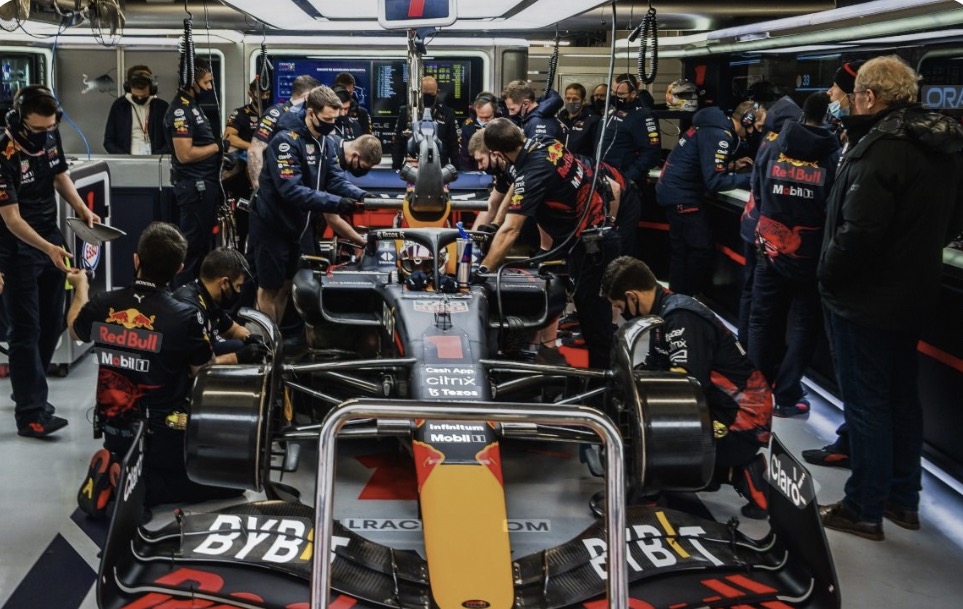
In Formula One, the conventional wisdom is that the best car wins. Watch a season and you will believe it. The team with the superior machine tends to finish ahead, year after year, and the racing press will tell you the championship is decided in the engineering bay long before it is decided on the track. Buy the better car, win the race. If that logic holds, then the lesson for business is obvious. Buy the better AI, win the market.
Here is the problem with that lesson, and it is the part almost everyone misses.
The reason the car looks decisive in Formula One is that every single driver on the grid is already elite. There are twenty seats in the world, and the people who fill them are generational talents who have been driving at the absolute limit since childhood. The variation between them has been squeezed down to hundredths of a second. When the human variable is that small, of course the remaining difference shows up in the machinery. The car appears to win because the driver pool was filtered to near perfection before the season ever started.
Business has no such filter.
This is the part most leadership teams get backwards. They treat AI as a procurement decision. It is a capability problem.
Look at how the decision actually gets made. In most large companies, AI still runs through the CTO’s office, scoped and purchased like any other enterprise system, evaluated for security, integration, and vendor fit. Those are the right questions for infrastructure. They are the wrong questions for capability. No vendor evaluation builds the fluency a leader needs to operate the thing once it arrives, which is why so much of that spend lands on the wrong side of the divide.
Remove the Filter and the Driver Decides
There is no governing body screening executives for AI fluency before they are handed the keys. The distribution of skill in business is not twenty elite drivers separated by a blink. It is a wide-open field where a few leaders are genuinely fluent, many have never truly operated the machine, and more than a few are convinced they are fast because they once asked a chatbot to clean up an email.
So the thing that makes the car look dominant in Formula One is the thing that does not carry over to your company. Strip away the selection bias and the driver becomes the dominant variable again. The same AI handed to a fluent leader and an unfluent one produces wildly different results, and the gap is not the technology. It is the person operating it.
The research backs this up plainly. A Gartner analysis found that executive AI literacy does not require coding or technical expertise, but it does require the strategic intelligence to interrogate assumptions, weigh risk, and align AI with real business priorities. Leaders without it tend to approve initiatives they do not understand and overestimate what the technology can deliver.2 That is a driver climbing into a championship car with no feel for what the machine is telling them, then blaming the car when the lap is slow.
If you are a senior executive trying to bring an AI partnership into supply chain operations, predictive maintenance, or asset management, you cannot give clear direction to your technical center of excellence when you have no personal feel for where a model’s context runs thin and where it holds.
Nobody Hands a Beginner an F1 Car
Here is the detail that turns this from a clever comparison into something useful. Those elite drivers did not arrive elite. Every one of them spent years in karting, then junior formulas, building feel through thousands of laps before they were ever allowed near the top machinery. The driver variable is compressed at the top precisely because everyone there has already done the developmental work.
Most executives are being handed the equivalent of a Formula One car having skipped karting entirely. They sit down, the performance is not there, and the natural reaction is to question the vehicle. But the vehicle is not the issue. The missing piece is the development path that every elite performer treats as non-negotiable, the unglamorous hours that build the instinct to feel what the machine is doing and tell the engineers what to change.
That feedback loop is the heart of it. In racing, the engineering team has all the telemetry in the world, but the driver feels things the data cannot capture. The rear is loose on corner exit. The front end is washing out under braking. The setup only improves because the driver can describe, with precision, what is wrong. A driver who cannot articulate the problem gets a car that never gets better.
Map that onto your own situation. Your AI coach, your center of excellence, or your technical partners can build you a beautifully tuned environment, but only if you can tell them what good output feels like, where the context is thin, and where the persona is off. The leaders I watch pull ahead are using AI before board meetings, before hard conversations, before strategic reviews, and again after every major decision, until the feel becomes second nature. They make the whole system better. The unfluent leader shrugs, says the AI is not useful, and climbs out of the car, which tells the engineers nothing at all.
Won on Development, Not on Lap One
The leaders who treat AI fluency as a personal discipline pull away from the field the same way a sharp engineering partnership wins a season, not in a single dramatic overtake but through a tenth of a second found every weekend, compounding across the calendar into a gap no one can close. This is the part that should keep you up at night, in a good way. The advantage does not arrive all at once. It accumulates, quietly, in favor of whoever started doing the laps first.
Which brings me back to that ninety-five percent. The companies on the wrong side of the divide did not buy worse technology. They skipped the development work and expected the machine to carry them. The few on the right side understood that personal mastery has to come before organizational deployment, and that you cannot direct a system you have never learned to drive.
You do not need to become a technical expert. You need to do the equivalent of your karting laps. Fifteen minutes a day, real reps, building the feel for what this partnership can and cannot do, until you can tell the difference between a setup problem and a driver problem. That is the race. Most leaders do not even know it has started.
The leaders reading this do not have an AI problem; they have an executive AI fluency problem. They have an executive team that was handed the machine without the development path. If that is the gap you are looking at, that is the work I do with leadership teams, building the fluency before the deployment so the capability is there when the tools arrive. If you want to talk about your own team, email me directly at info@kcestenson.com. That conversation is where this usually starts.
It is also where the team often starts together, working through The Augmented Leader as a shared development path from AI-curious to AI-integrated. You can find the book on Amazon, and more on the work at kcestenson.com.
- Aditya Challapally, Chris Pease, Ramesh Raskar, and Pradyumna Chari, The GenAI Divide: State of AI in Business 2025, MIT NANDA (Networked Agents and Decentralized AI), July 2025. ↩︎
- “The Leadership Blind Spot: Why Executive AI Literacy Will Shape Business Outcomes,” The European Business Review, March 2026, reporting Gartner research. ↩︎